Style Arcade
From Spreadsheets to Smart Dashboards: Streamlining Fashion Buying Decisions
Transforming fashion brand workflows by designing analytics dashboards and collaborative tools, integrating disconnected processes into a single, user-friendly SaaS platform, with rapid prototyping in Figma to validate MVPs and increase feature adoption.
Problem Context
Style Arcade is a SaaS startup supporting fashion brands in range planning and buying decisions through analytics dashboards and collaborative tools. Buying teams were heavily reliant on spreadsheets and manual processes, creating inefficiencies, miscommunication, and financial risk in predicting volumes and planning ranges.
Role: UX/UI Designer
Platform: Figma | Web | Responsive Design
Year: 2020
Team
Working Across Product, Merchandising, Sales, and Development
I collaborated closely with the Founder, a Merchandiser, Sales team members, and Developers to co-design dashboards and tools that reflected real user workflows. This cross-functional collaboration ensured the product aligned with client needs, operational realities, and technical feasibility while maintaining usability and design consistency.
Challenge
Fragmented Workflows and Slow Decision-Making in Fashion Buying
Existing processes lacked visibility and cohesion across buying, design, and sales teams. Teams worked in disconnected tools, causing delays, misalignment, and costly errors in range planning. Rapid validation of MVPs was also essential to ensure the product met real client needs without delaying development or iteration.
Approach
Co-Designing Dashboards and Collaborative Tools to Streamline Workflows
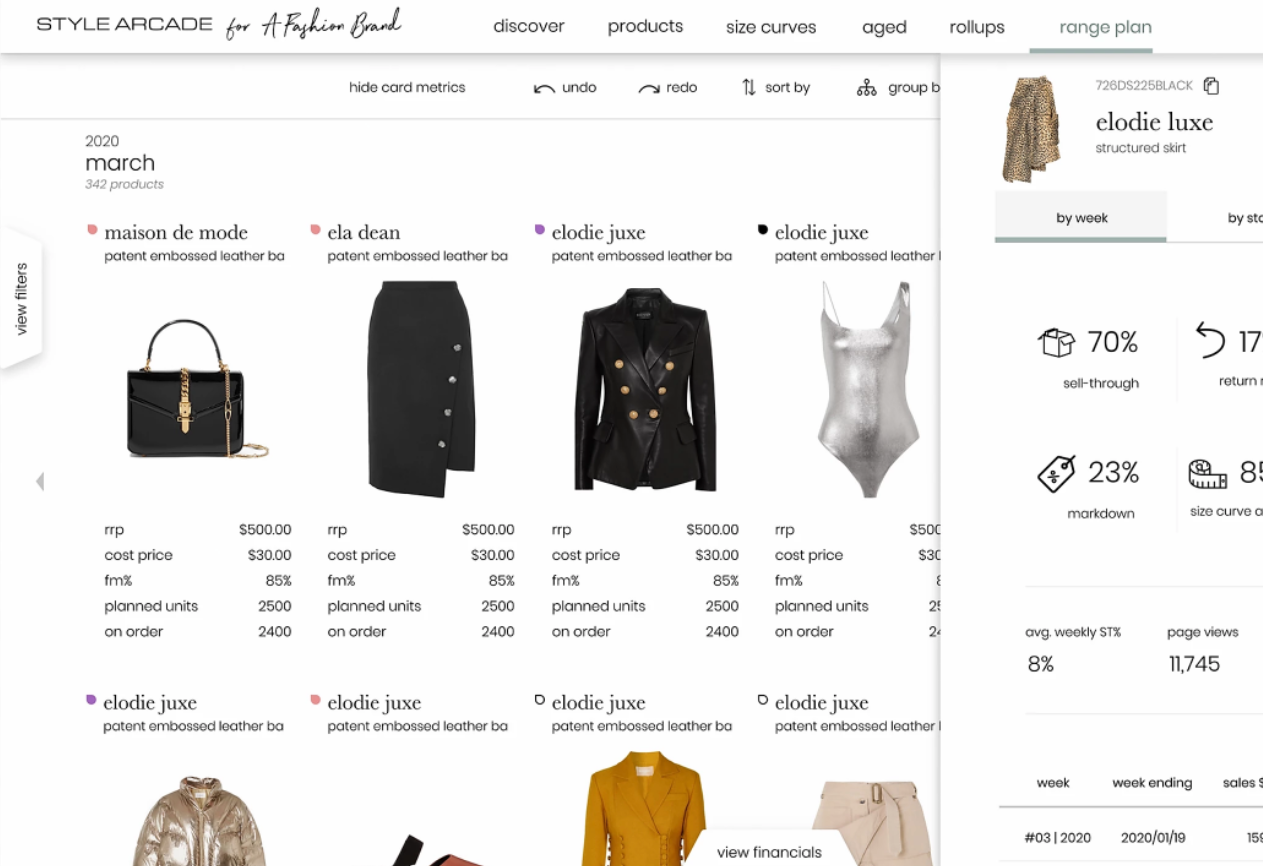
I co-designed a powerful analytics dashboard with the CEO to reduce decision-making time and save clients money by predicting buying volumes accurately. I designed a collaborative planning tool from scratch, integrating multiple disconnected workflows into a single platform for real-time alignment across departments. Rapid sketching, wireframing, and Figma prototyping allowed early testing of core features, while co-design sessions with team members working directly with clients generated actionable feature ideas.
Outcome
Reduced Errors, Faster Decisions, and Improved Cross-Team Collaboration
The redesigned dashboards and collaborative tools significantly reduced time spent on manual processes, improved feature adoption, and enabled real-time alignment between buying, design, and sales teams. Rapid user testing and co-design validation ensured the product solved real client pain points, helping brands make smarter, data-driven decisions.